

How do you handle repair warranties without arguments?
To handle a repair warranty, write down the work it covers, how long it lasts, and the date its term starts. If the device comes back, compare the fault with the original order and its warranty term. If it is a different fault, explain why it needs a new job.

A written record gives both sides something to discuss.
Why do warranties end in arguments?
Because the terms were almost never written down. They were spoken.
At the counter, on pickup day, "bring it back if anything happens" sounds generous and takes two seconds. Three weeks later that same sentence means one thing to the customer and another to the shop, and there is no way left to tell which one it was.
The argument does not start the day the device comes back. It starts on pickup day, in the sentence nobody wrote down.
What does a repair warranty actually cover?
The work that was done and the part that was fitted. Not the whole device.
That is where nearly all the confusion lives: the customer understood that the device was under warranty, and the shop understood that it was backing one specific repair. If the heating element of a hair dryer was replaced and the switch fails ten days later, the switch was never covered, not because the shop is going back on its word, but because it was never touched.
So the warranty is written about the repair, with the name of the work beside it. A warranty that does not say which repair it covers does not cover anything specific, and whatever is not specific gets argued about.
What date does the clock start on?
A date the customer can read on their own paper. Which date it is matters less than the fact that it is printed.
Some shops count from the order date and others from the day the work is completed; what does not work is the shop counting from one date and the customer from another. If you count from the order date, be careful not to promise too much: a device that is repaired quickly and then sits on the shelf for two weeks waiting to be collected uses up those two weeks of warranty.
Which is why telling the customer their repair is ready on time stops being a courtesy: if the customer collects it promptly, they have more warranty days left to use it.
How many days should you give?
As many as you can stand behind without looking at the ceiling.
Thirty days in writing are worth more than ninety promised out loud. A short, clear term gets respected; a long, vague one gets argued about, and it gets argued about precisely when you no longer remember what you did. Assistant ships with thirty days and the shop changes them if it wants to.
And if a repair cannot carry a warranty, that gets written down too. On the desktop ticket that line is not left blank: it prints "N/A", because a gap looks like an oversight and "N/A" says somebody decided.

How do you check at the counter whether an order is still under warranty?
By pulling up the earlier order, not anybody's memory.
What settles it is not what the customer remembers or what the technician remembers: it is the order from that day, with its date, what was repaired and the term it carried. That is why what goes on a well-made repair ticket matters so much the day a device comes back, because the paper from back then is what closes today's conversation.
In Assistant every device has its own record: how many times it has come in, each order with its date and its code, and whether that order's warranty is still live, already expired, or why there was none. That turns an argument into a lookup.
What if it comes back with a different fault?
Then it is not a warranty claim: it is a new order.
It is worth saying so the same day and without hedging, because this is the conversation that rots fastest if it is left for later. The device gets checked, and if what fails today is not what was repaired back then, a normal order is opened with its own quote. Coming in as a new order does not mean treating the customer as a first-timer: it means the work gets charged and the reason gets written down.
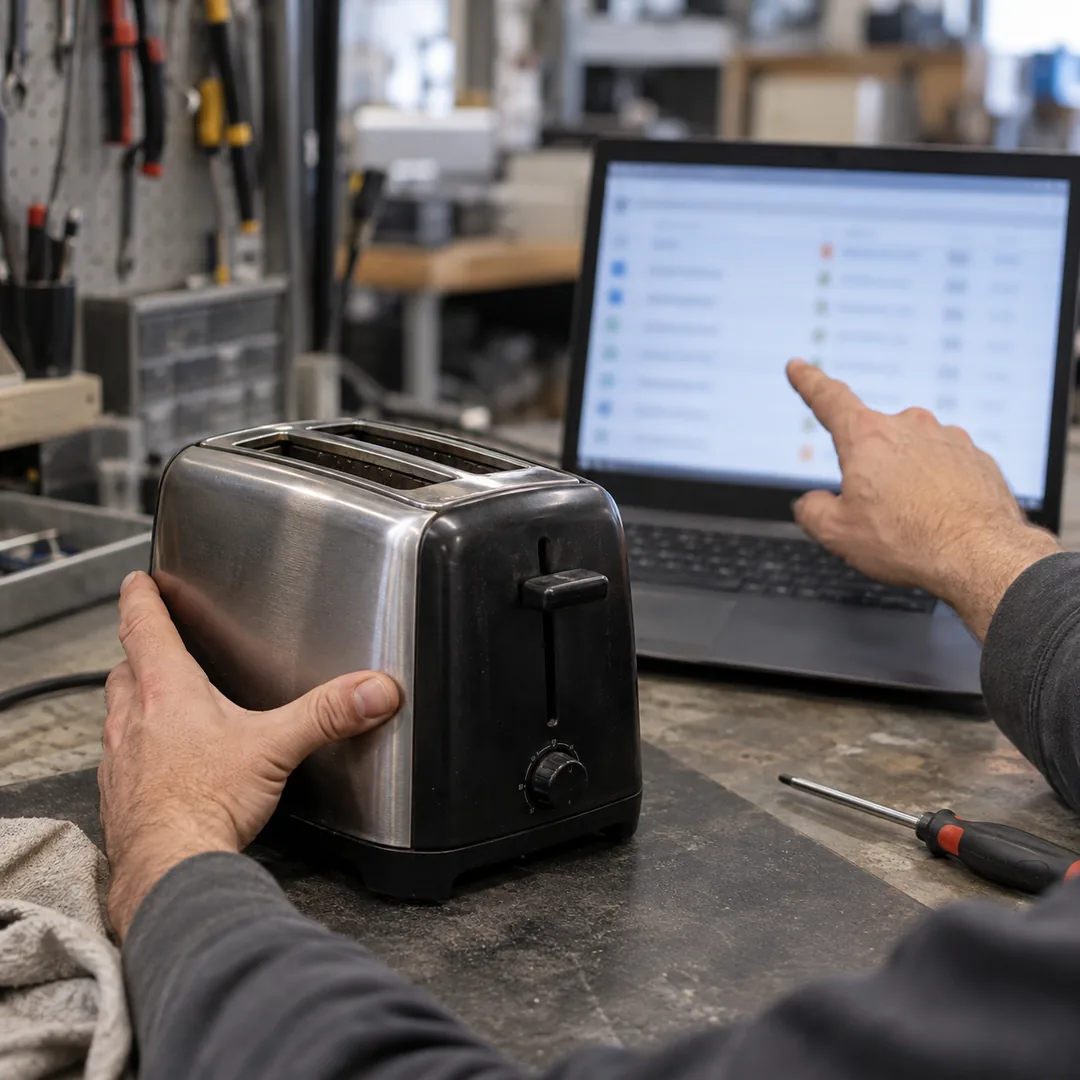
Assistant helps you not skip that step: when you reopen an order that was already closed, it asks, device by device, whether this is warranty work or rework, which is the same question as who pays. And it keeps the trail visible, because on the ticket a device that comes back shows up as "RT" with the number of the order it came from and how it ended this time.
Does the warranty restart after a warranty repair?
No, and that is on purpose.
If every repair done under warranty opened a fresh warranty, the term would never end: coming back once a month would be enough to keep the device covered for life. At the counter the rule is easy to say and easy to defend: the warranty runs from the original repair, and coming back does not stretch it.
The same goes for what could not be fixed. A device that went out as not repairable carries no warranty, because you do not guarantee what you did not repair.
What should a warranty not cover?
Whatever was not in your hands.
A fresh drop, liquid, a device another shop opened afterwards, a part the customer brought in. You controlled none of it, and a warranty that covers everything is not generous: it is impossible to stand behind, and the first time you have to stand behind it you will want to break it. Those exclusions go on the same paper as the term, because an exclusion that lives only in your head does not exist the day you need it.
And half the argument is avoided much earlier: what information to collect when a device comes in and photographing every device when it comes in are what let you show the condition it arrived in.
How many devices come back to you?
That is the question that turns warranties into information.
A device that comes back is a cost, but it is also a warning: about a poor-quality part, a weak supplier, a rushed diagnosis. If nobody counts them, the warning never arrives. The Assistant pickup ticket closes with the day's counts: how many devices went out repaired, how many under warranty and how many not repairable; and separately, outside that total, how many had come back to the shop.
It sits apart on purpose, and the reason is worth understanding: a device that comes back ends up repaired, or under warranty, or not repairable, so adding it to the total would count it twice. It is a measure of how many return, not a fourth category.
What three things should you put in writing?
They go on the paper the customer takes home, not in the conversation at the counter.
What was repaired, with the name of the work or the part. Through what date, with the date filled in. And what falls outside, in one line. With those three, if a device comes back, you and the customer can refer to what was agreed instead of relying on memory.
None of this needs an expensive system: it needs a complete ticket and a way to check warranties before they expire. The other half of the job is organizing repair orders so none get lost, and there Assistant flags for you the ones expiring in the next fifteen days. The Paradoxon Assistant download is free.